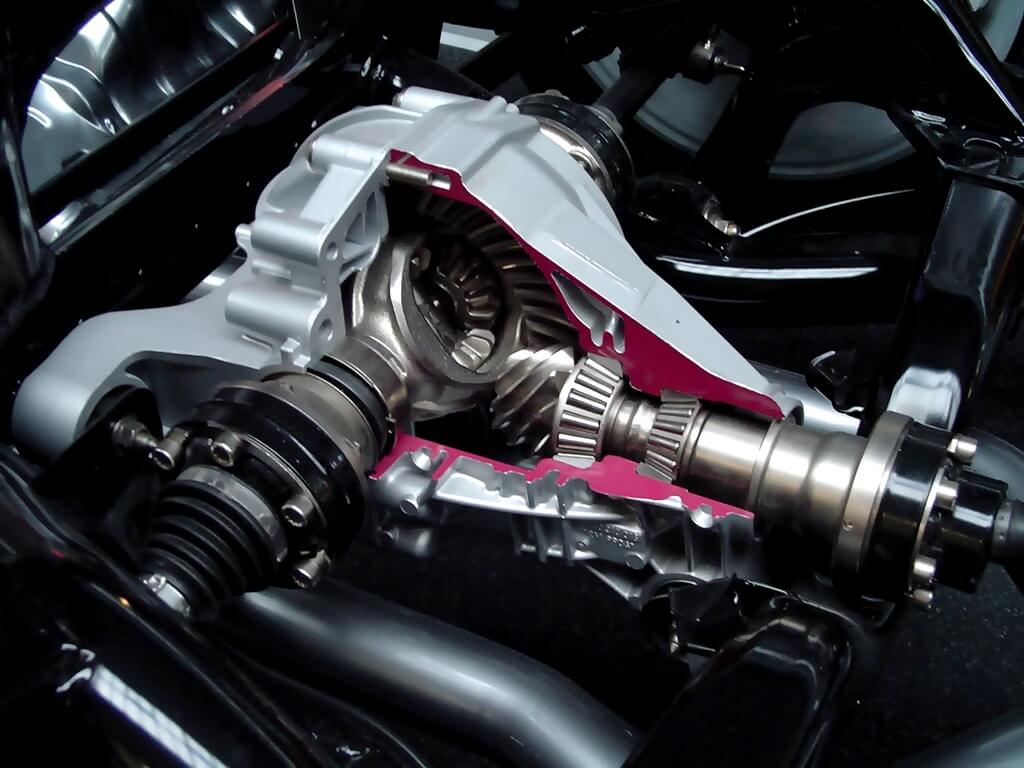
The main task of the differential – in car slang, difi – is to transfer the engine's torque to the wheels. This fantastic invention was designed to solve the problem that when cornering, the wheel on the inside of the curve makes fewer revolutions than the wheel on the outside of the curve. So if the two wheels were fixed on the same axle, different tension and shear forces would occur, and the wheels would slip, which would make cornering stability very poor.
Jumping forward a bit, today, in certain supercars and racing cars, there are solutions that brake the inner wheel and provide extra torque to the outer wheel, thus increasing the available cornering speed.
The differential was invented by French engineer Onésiphore Pecqueur. He designed the original device for a steam-powered vehicle and patented it in 1827.
So, the main tasks of the DFI are:
- transmitting engine power to the wheels
- balancing the speed of the wheels on the outside and inside of the arc
- When driving straight, both wheels should rotate at the same speed
Its operating principle

The mechanism – if the vehicle is rear-wheel drive – receives its drive from the cardan shaft, which it turns 90 degrees with the help of the ring gear and bevel gear. (It is present in front-wheel drive cars when it is integrated into the transmission.) When cornering, due to the greater resistance acting on the inner wheel, the gears (planetary gears) inside the differential start to rotate, so the outer wheel can rotate faster and the inner one slower.
Types of differential
The most common type is the open differential , which splits torque 50/50. The disadvantage is that if one wheel loses traction (e.g. spins out on ice), it does not transfer drive to the other wheel with good traction.
- A lockable differential tIt is used in off-road vehicles, where with the push of a button or switch the effect of the differential can be eliminated and the wheels rotate together, ensuring maximum traction on loose ground.
- Az Limited slip differential sused in sports cars and higher performance vehicles; automatically limits the speed difference between the wheels if one wheel is about to spin out. This allows for greater cornering stability and better standing starts. Also a great help in winter on snow and ice.
Like all rotating parts, the differential can fail, but it generally has a long lifespan. The main cause of failure is inadequate lubrication, which can be caused by leaks, for example, but prolonged extreme loads can also kill the differential.
The main symptoms include a humming, grinding or clicking sound coming from the differential (especially when accelerating or cornering), and a jerky drive.
In short, the differential now lives with us and does its job, our cars are almost unimaginable without it. Although if we look at those electric cars where each wheel, or only the front or rear wheels, is driven by a separate hub motor, there is no need for a differential anymore. Next year the differential will be 100 years old. We will see what the next 100 years bring.

Subscribe to Autosajto.hu to your newsletter